
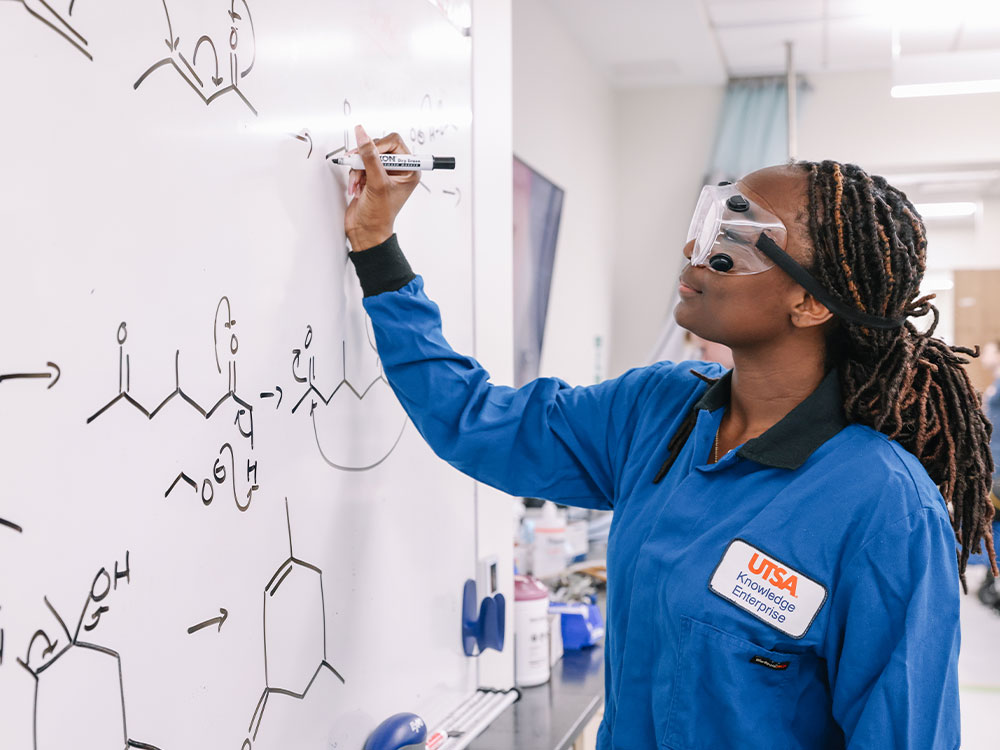
Why Pursue a PhD in Chemistry
The Department of Chemistry offers opportunities for advanced study and research leading to the Doctor of Philosophy degree in Chemistry. The PhD in Chemistry is awarded to candidates who have displayed an in-depth understanding of the subject matter and demonstrated the ability to make an original contribution to knowledge in their field of specialty.
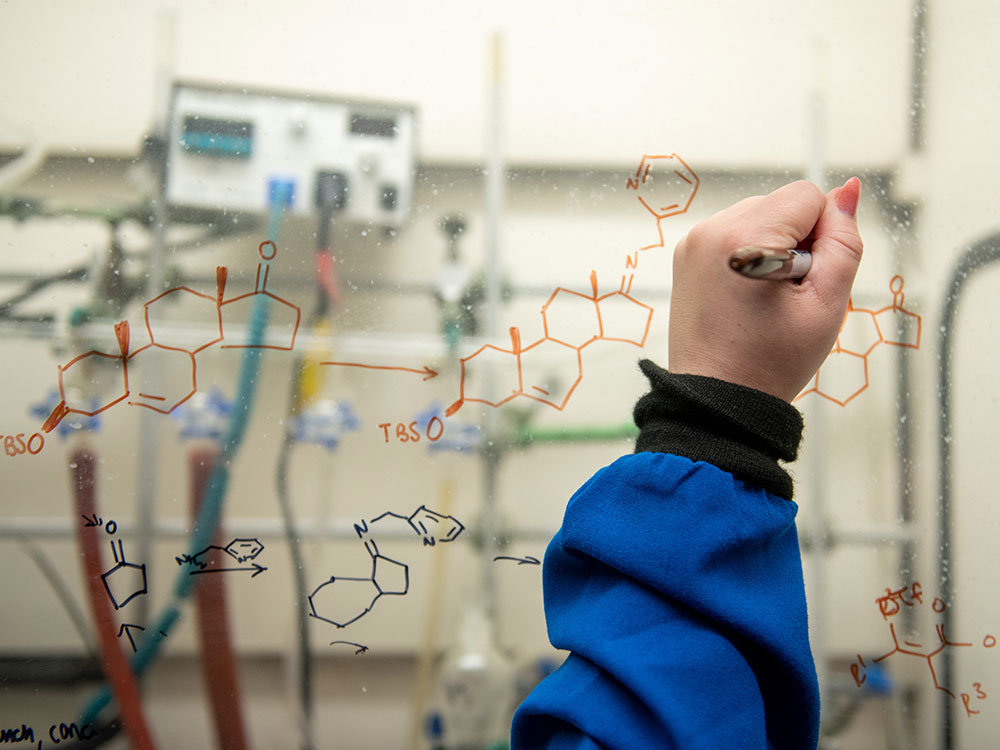
Research Opportunities
The PhD in Chemistry offers high quality research in the areas of Catalysis, Drug Discovery, Enzymology, Structural Biology, Materials Science, Surface Science, Nanoscience, Computational and Data Science across the traditional subdisciplines of Chemistry. Graduate students have access to world class core facilities, such as NMR, mass spectroscopy, X-ray diffraction, high performance computing, electron microscopy, proteomics, biophotonics, chemical pharmacology, and drug discovery.
Admission & Application Requirements
Applications are submitted through the UT San Antonio Graduate Application. Please upload all required documents (listed below) on your UT San Antonio Graduate Application. It is the applicant’s responsibility to ensure completion and submission of the application, a nonrefundable application fee, and all required supporting documents are on file with UT San Antonio by the appropriate application deadline.
| Chemistry (PhD) | ||
|---|---|---|
| Admission is only available for the Fall semester | ||
| Required Degree | Bachelor's Degree from an accredited college or university in the United States or have proof of equivalent training at a foreign institution. | |
| Minimum GPA | 3.0 (on a 4.0 scale) Departments may consider GPA of last 60 semester credit hours | |
| Coursework | Completed adequate credit hours or foreign institution equivalent coursework as preparation for the program. | |
| Transcripts* | Required from all institutions attended; international transcripts must be recorded/translated to English | |
| Credential Evaluation | Required if you have earned university-level credit from foreign institutions. Submit an evaluation of your transcripts from FCSA or any NACES-approved credential evaluation agency. | |
| English Language Proficiency | 79 TOEFL iBT / 6.5 IELTS / Duolingo 100 For exams taken on or after January 21, 2026: We require a minimum TOEFL iBT score of 4.0. |
|
| Purpose Statement | Required | |
| Resume | Required | |
| Letters of Recommendation | 2 academic or professional reference(s) demonstrating your attributes for successful completion of this program (you will request these through the Graduate Admissions Application; let your recommenders know of your deadline to ensure submissions are on time) | |
| *Unofficial transcripts will be taken into consideration for admissions; however, if admitted into the program, you must submit official transcripts to the University. | ||
Application Deadlines
Applicants are encouraged to have their admission file completed as early as possible. All applications, required documents and letters of recommendation, if applicable, must be submitted by 5:00 PM U.S. Central Time on the day of the deadline. Deadlines are subject to change.
| Chemistry (PhD) | |||
|---|---|---|---|
| Timing on Admission Decision: Completed applications are reviewed after the application deadline. Admission decisions are released following review committee meetings from mid-February through mid-April. | |||
| Application Deadlines for: | Priority | International | Domestic |
| Fall 2027 | December 1 | December 1 | |
| Spring | Not Available | Not Available | |
| Summer | Not Available | Not Available | |
Funding Opportunities
Qualified students are encouraged to apply for teaching and/or research assistantships and fellowships. Requests should be sent to the Graduate Advisor of Record for chemistry when application is made for admission to the institution.
Career Options
UT San Antonio prepares you for future careers that are in demand. The possible careers below are based on data pulled by a third-party tool called Emsi, which pulls information from sources like the U.S. Bureau of Labor Statistics, U.S. Census Bureau, online job postings, other government databases and more to give you regional and national career outlook related to this academic program.
While in a doctoral program, a student may earn a master’s degree provided the following conditions are satisfied:
- A student must be admitted to candidacy.
- A student is eligible to receive a master’s degree upon completion of University-wide requirements and any additional degree requirements specific to the program.
- The Doctoral Studies Committee, Department Chair, and the Graduate Associate Dean of the College must recommend students for the degree.
- The student must apply for graduation by the published deadline the semester prior to awarding the doctoral degree.
- All required coursework in the doctoral program at the time of admission to candidacy must have been taken within the previous six years.
- If the master’s degree requires a thesis, the degree cannot be awarded on the basis of the doctoral qualifying examination.
- Students will not be approved for an additional master’s degree in the same field in which an individual has previously received a master’s degree.
This program is housed on Main campus.
Frequently Asked Questions
The Department of Chemistry offers graduate students research opportunities in five principal areas: Analytical Chemistry, Biochemistry, Inorganic Chemistry, Organic Chemistry and Physical Chemistry.
On average, our doctoral students graduate after four to five years of study. Funding is guaranteed for eligible students for up to five years.
There are several admission requirements, including a certain GPA, letters of recommendation, English Language Proficiency where relevant and more. For admission requirements, please see the program page.
Yes, research assistantships are available where possible, but they are not guaranteed. Some students may work as a GTA throughout their doctoral degree – it is dependent on both funding and supervisor.
Most PhDs in chemistry are laboratory based.
In the News
A UT San Antonio researcher is working on a device that addresses a longstanding roadblock in surgically removing cancerous cells. This “smart probe,” developed by Syed Muhammad Usama, PhD, assistant professor in the Department of Chemistry, will make hidden cancerous cells glow during surgical operations and allow doctors to more easily identify and remove the residual cancer tissue, reducing the risk of cancer returning in recovered patients. The research is targeting an aggressive form of breast cancer, and could mark significant progress in effectively treating the disease.
Read the full story “UT San Antonio chemist develops probe to illuminate breast cancer cells” to learn more about this contribution to health science.
UT San Antonio researchers are working with the Southwest Research Institute (SwRI) to study tetrapeptides. These peptides are formed when four various strings of four amino acids, also known as the building blocks of life, link together. In understanding more about these peptides and how their chemical reactions can be accelerated, researchers are hoping to improve pharmaceutical development, particularly in GLP-1s, which are growing in popularity as a drug used to treat diabetes and help weight loss.
Read the full story “UT San Antonio researchers help unlock the potential of peptide catalysts” to learn more about this innovative research.
For more news stories, visit UT San Antonio today.
