Why Pursue a Computer Science PhD
The Department of Computer Science offers comprehensive programs at both undergraduate and graduate levels, with approximately 1,761 undergraduates, 135+ master’s students and 65+ doctoral students. The Computer Science doctoral program offers opportunities for students to do advanced research in many fields. The research activities and experimental facilities have been well-supported by various federal research and infrastructure grants.
Research Opportunities
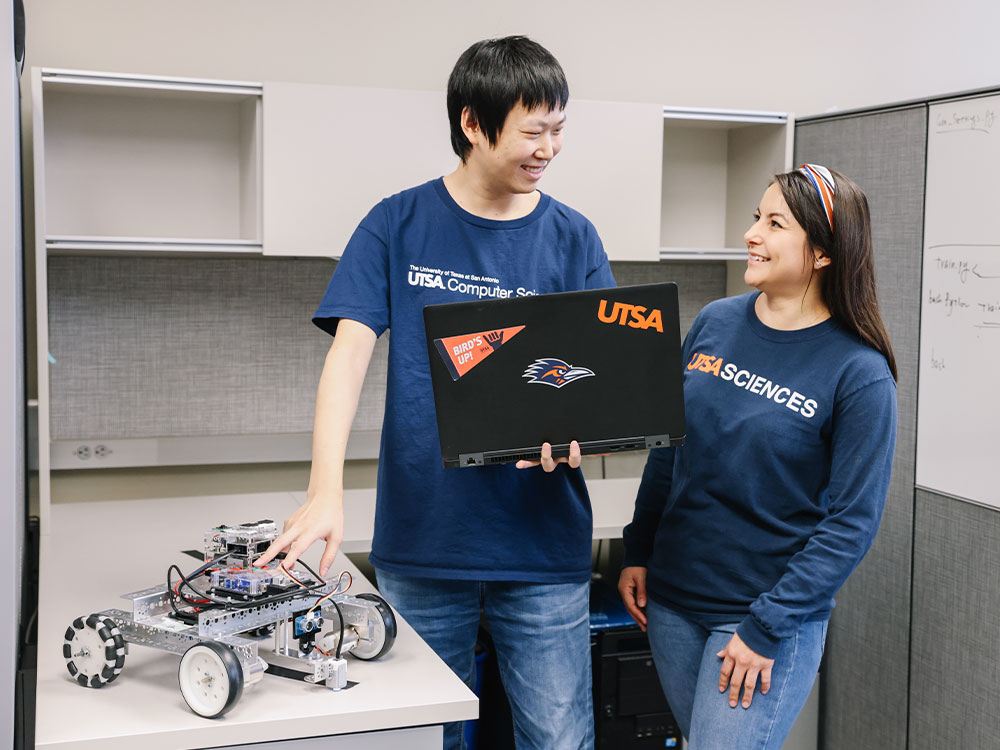
The research in the Department of Computer Science is supported by more than $10M in active research grants and contracts from various external funding agencies. PhD students conduct innovative research in cooperation with and under the supervision of department faculty. Activities of research assistants include implementing prototype systems, developing and proving new theories, conducting experiments, attending international conferences, and publishing their results in scientific journals.
The department’s 28 faculty members conduct research in a variety of areas including algorithms, bioinformatics, computer and information security, computer architecture, computer networks, databases, high performance computing, parallel and distributed systems, programming languages and compilers, and software engineering among others.
College of AI, Cyber and Computing
This program is part of the UT San Antonio College of AI, Cyber and Computing, which advances expertise in artificial intelligence, cybersecurity, computing and data science to meet the needs of a rapidly evolving technology landscape. The college fosters interdisciplinary collaboration, applied research and engagement with industry partners to drive innovation and address real-world challenges.
Admission & Application Requirements
Applications are submitted through the UT San Antonio Graduate Application. Please upload all required documents (listed below) on your UT San Antonio Graduate Application. It is the applicant’s responsibility to ensure completion and submission of the application, a nonrefundable application fee, and all required supporting documents are on file with UT San Antonio by the appropriate application deadline.
| Computer Science (PhD) | ||
|---|---|---|
| Required Degree | Bachelor's Degree from an accredited college or university in the United States or have proof of equivalent training at a foreign institution. | |
| Minimum GPA | 3.0 (on a 4.0 scale) Departments may consider GPA of last 60 semester credit hours | |
| Coursework | Completed adequate credit hours or foreign institution equivalent coursework as preparation for the program. | |
| Transcripts* | Required from all institutions attended; international transcripts must be recorded/translated to English | |
| Credential Evaluation | Required if you have earned university-level credit from foreign institutions. Submit an evaluation of your transcripts from FCSA or any NACES-approved credential evaluation agency. | |
| English Language Proficiency | 79 TOEFL iBT / 6.5 IELTS / Duolingo 100 For exams taken on or after January 21, 2026: We require a minimum TOEFL iBT score of 4.0. |
|
| Purpose Statement | Required | |
| Resume | Required | |
| Letters of Recommendation | 3 academic or professional reference(s) demonstrating your attributes for successful completion of this program (you will request these through the Graduate Admissions Application; let your recommenders know of your deadline to ensure submissions are on time) | |
| *Unofficial transcripts will be taken into consideration for admissions; however, if admitted into the program, you must submit official transcripts to the University. | ||
Application Deadlines
Applicants are encouraged to have their admission file completed as early as possible. All applications, required documents and letters of recommendation, if applicable, must be submitted by 5:00 PM U.S. Central Time on the day of the deadline. Deadlines are subject to change.
| Computer Science (PhD) | |||
|---|---|---|---|
| Timing on Admission Decision: Completed applications are reviewed in batches after the application deadline. Admission decisions are released within 4 to 6 weeks after the posted deadline. | |||
| Application Deadlines for: | Priority | International | Domestic |
| Spring 2027 | October 1 | October 1 | |
| Summer 2027 | Not Available | Not Available | |
| Fall 2027 | February 1 | February 1 | |
| Spring 2028 | Not Available | Not Available | |
| Summer 2028 | Not Available | Not Available | |
Funding Opportunities
All full-time, admitted PhD students are welcomed with an appointment as either a Graduate Teaching Assistant (GTA) or Graduate Research Assistant (GRA). This is comprehensive support that comes with a tuition waiver, stipend, and health insurance. The stipend starts from $24,000 per year, and the total value of the financial support package is more than $42,000 yearly. The Computer Science PhD program is designed so that students who are admitted as GTAs find a doctoral advisor during their first year of study.
Learn MoreCareer Options
UT San Antonio prepares you for future careers that are in demand. The possible careers below are based on data pulled by a third-party tool called Emsi, which pulls information from sources like the U.S. Bureau of Labor Statistics, U.S. Census Bureau, online job postings, other government databases and more to give you regional and national career outlook related to this academic program.
While in a doctoral program, a student may earn a master’s degree provided the following conditions are satisfied:
- A student must be admitted to candidacy.
- A student is eligible to receive a master’s degree upon completion of University-wide requirements and any additional degree requirements specific to the program.
- The Doctoral Studies Committee, Department Chair, and the Graduate Associate Dean of the College must recommend students for the degree.
- The student must apply for graduation by the published deadline the semester prior to awarding the doctoral degree.
- All required coursework in the doctoral program at the time of admission to candidacy must have been taken within the previous six years.
- If the master’s degree requires a thesis, the degree cannot be awarded on the basis of the doctoral qualifying examination.
- Students will not be approved for an additional master’s degree in the same field in which an individual has previously received a master’s degree.
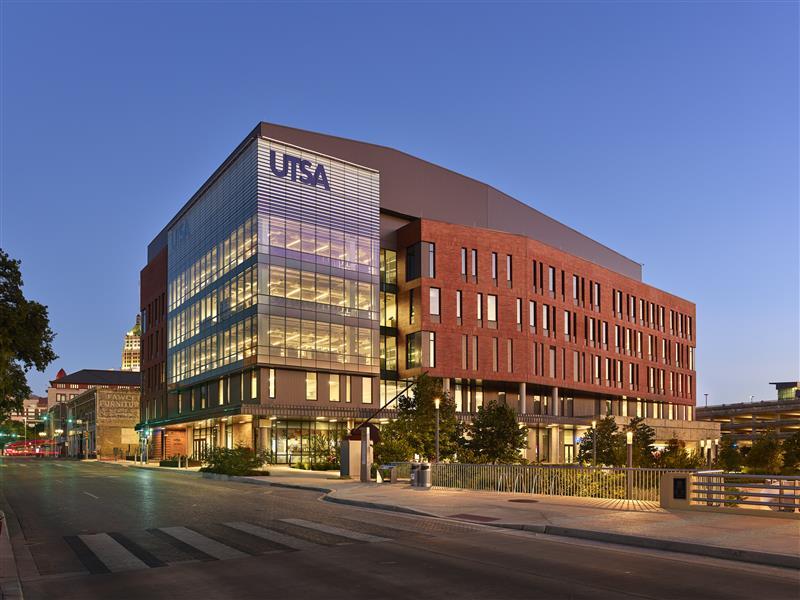
Faculty offices and research labs for Computer Science are located both on the Main Campus and Downtown Campus (San Pedro I building). Graduate courses are held in San Pedro I. Courses are scheduled in late afternoons and evenings, accommodating part-time student schedules very well.
Frequently Asked Questions
- Algorithms
- Quantum computing
- Computer architecture
- Cloud computing
- Parallel computing
- Distributed systems
- Cybersecurity and privacy
- Artifical intelligence
- Fundamental system designs
- Hardware
- Algorithms
- Optimizations for low-power embedded and IoT devices
- Distributed and high-performance computing
- Cloud computing and data centers
- Bio-informatics
- Computer architecture
- Computer networks and software engineering
Most students complete the program in 4-6 years, but have up to 8 years to finish their doctoral degree which includes up to 6 years from admission to candidacy plus 2 years for the dissertation phase.
The PhD in Computer Sciences prepares graduates for careers such as:
- Academic Careers (Teaching & Research) – professorship, postdoctoral research, and academic leadership.
- Industry Research (Advanced industry roles) – Government and national labs. Startups and entrepreneurship.
The Computer Science program at the UT San Antonio actively engages in significant research collaborations and industry partnerships across academia, government and the private sector, which can benefit PhD students and researchers in the program.
Affiliated research centers:
- Institute for Cyber Security
- AI Matrix Consortium
- Center for Infrastructure Assurance and Security
- Open Cloud Institute
Affiliated Research Labs:
- Advanced, Sustainable, and Intelligent Computer System Lab
- AI Trustwortiness Lab
- Bioinformatics Research and Development Group
- Cloud Systems Lab
- Cohort for AI Responsibility
- Engaging Computing Group
- Home to IoT Assurance Lab
- Large-Scale System Optimization Resarch Lab
- Next Generation Networks Lab
- Parallel Data Intensive Computing and Machine Learning Lab
- Real-time and Embedded Systems Lab
- San Antonio Geometry Algorithms Lab
- San Antonio Virtual Enviroments Lab
- ScooterLab
- Security, Privacy, Trust and Ethics in Computing (SPriTE) Lab
- The Society-Based Data Science Lab
- Software Engineering and Formal Methods Lab
- Software Evolution, Reliability, and Security Lab
- SPriTELab, Systems and Networks Lab
- Vision and Artificial Intelligence Lab
- Vision and Immersive Realities Lab
Yes! All full-time, admitted PhD students are welcomed with an appointment as either a Graduate Teaching Assistant (GTA) or Graduate Research Assistant (GRA). This is comprehensive support that comes with a tuition waiver, stipend and health insurance. The stipend starts from $24,000 per year, and the total value of the financial support package is more than $42,000 yearly. The Computer Science PhD program is designed so that students who are admitted as GTAs find a doctoral advisor during their first year of study.
In the News
UT San Antonio has been recognized by the National Security Agency (NSA) as a National Center of Academic Excellence in Cyber Research (CAE‑R), a prestigious designation that reflects the strength of its doctoral programs in Information Technology and Computer Science. This designation is awarded only to universities that demonstrate exceptional doctoral‑level cybersecurity research and education and confirms that UT San Antonio meets rigorous federal standards for advancing the nation’s cybersecurity capabilities.
UT San Antonio has been a leader in cybersecurity education for more than two decades, becoming the first university in Texas to earn an NSA Center of Academic Excellence designation in 2002 and receiving its first Cyber Research designation in 2009. Today, its PhD programs in Information Technology and Computer Science are supported by a highly active research ecosystem that includes nearly 30 specialized labs and nationally recognized research centers such as the Center for Data Science, Institute for Cyber Security (ICS), Center for Infrastructure Assurance & Security (CIAS), MATRIX: The UTSA AI Consortium for Human Well-Being, and the Open Cloud Institute.
This national recognition is further strengthened by UT San Antonio’s College of AI, Cyber and Computing, which integrates cybersecurity with artificial intelligence, computing, and data science to address real‑world government, military, and industry needs. For doctoral students, this means opportunities to conduct high‑impact research, work alongside faculty recognized at the federal level, and help advance solutions to critical national security challenges.
Read the full article “UT San Antonio recognized for exceptional research in cybersecurity” to learn how UT San Antonio’s doctoral programs are helping protect the nation’s digital future.
Researchers at The University of Texas at San Antonio have released a new study examining risks associated with using artificial intelligence tools to develop software. The research finds that large language models commonly generate insecure or incorrect code, including a specific issue known as package hallucination, in which an AI model recommends third‑party software libraries that do not exist. The study was led by Joe Spracklen, a UT San Antonio doctoral student in computer science, and has been accepted for publication at the USENIX Security Symposium 2025, a leading international cybersecurity and privacy conference. According to the researchers, these AI‑generated errors can pose serious security risks because they can occur through routine coding commands and are difficult for users to detect. The research involved a multi‑institutional team and highlights the need for greater awareness and safeguards as AI‑assisted programming becomes more widespread.
Read the news release “AI threats in software development revealed in new study from The University of Texas at San Antonio” on eurekalert.org.
This study has also been written about on scienmag.com. Read “New Study from The University of Texas at San Antonio Uncovers AI Threats in Software Development” for more on how UT San Antonio’s research is contributing important evidence to a growing conversation about the security implications of AI‑assisted software engineering.
A team of researchers at the University of Texas at San Antonio, led by Chen Pan, PhD, assistant professor of electrical engineering in the Klesse College of Engineering and Integrated Design, have engineered a self-sustaining flood warning system that detects local dangerous water accumulation at street-level. Pan is joined by assistant professor of computer science in the College of AI, Cyber and Computing, Mimi Xie. The system, powered by artificial intelligence, relies on solar energy harvesting to provide an off-grid system that generates its own power, as other warning systems often fail along with local power infrastructure right as severe weather hits. The field-ready prototype will provide rural and coastal areas in the state with a more reliable flood warning system.
Read the full story “UT San Antonio researcher builds self-powered, smart warning system to catch local floods” to learn more about this incredible advancement.
Assistant professor at the College of AI, Cyber and Computing, Nishant Vishwamitra, PhD, is tackling a challenge brought on by more frequent usage of AI generation in the coding sphere. Software coding generated or assisted by AI can often create security flaws in the code. A new learning platform developed by Vishwamitra and his team can help students practice identifying and fixing these kinds of flaws in a controlled environment. This training module is the first of its kind and will provide students with unique, valuable career skills.
Read the full story “Keeping the code safe: How UT San Antonio students are learning to build a safer AI” to learn more about this training module and the other initiatives of Vishwamitra’s ambitious project.
For more news stories, visit UT San Antonio today.