Why Pursue a PhD in Counselor Education?
This doctoral program is nationally accredited through the Council for Accreditation of Counseling and Related Educational Programs (CACREP). Department of Counseling faculty members are the leaders of international counseling associations, with positions such as former and current presidents and journal editors. Program graduates will have opportunity to learn from these faculty members and acquire advanced theoretical knowledge, advanced clinical skills, research skills and advanced clinical supervision skills.
Research Opportunities
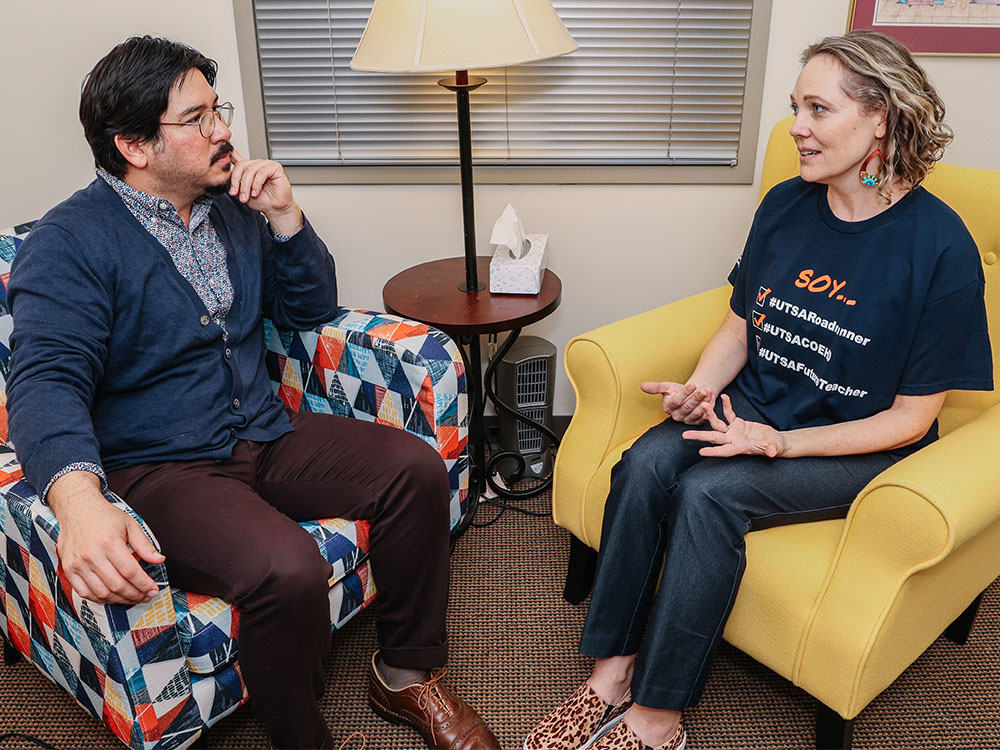
The PhD in Counselor Education conducts research in the following topics: creative interventions relative to relationship issues, grief and loss, Relational Cultural Theory, multicultural issues in counseling, behavioral health issues, brief family consultation, creative approaches to aging, on-line counseling, addictions, suicidal tendencies, crisis intervention, treatment of trauma, mentoring in the learning environment, legal and ethical issues in school counseling, injurious behaviors, rape and sexual assault.
See What Our Students Say
When you choose UT San Antonio, you join a community of talented students being taught by award-winning faculty. See what our students have to say.
Admission & Application Requirements
Applications are submitted through the UT San Antonio Graduate Application. Please upload all required documents (listed below) on your UT San Antonio Graduate Application. It is the applicant’s responsibility to ensure completion and submission of the application, a nonrefundable application fee, and all required supporting documents are on file with UT San Antonio by the appropriate application deadline.
| Counselor Education and Supervision (PhD) | ||
|---|---|---|
| Admission is only available for the Fall semester | ||
| Required Degree | Master’s Degree from an accredited college or university in the United States or have proof of equivalent training at a foreign institution. | |
| Minimum GPA | 3.0 (on a 4.0 scale) Departments may consider GPA of last 60 semester credit hours | |
| Coursework | Completed adequate credit hours or foreign institution equivalent coursework as preparation for the program. | |
| Transcripts* | Required from all institutions attended; international transcripts must be recorded/translated to English | |
| Credential Evaluation | Required if you have earned university-level credit from foreign institutions. Submit an evaluation of your transcripts from FCSA or any NACES-approved credential evaluation agency. | |
| English Language Proficiency | 100 TOEFL iBT / 7 IELTS / Duolingo 130 For exams taken on or after January 21, 2026: We require a minimum TOEFL iBT score of 5.0. |
|
| Purpose Statement | Required | |
| Resume | Required | |
| Letters of Recommendation | 2 academic or professional reference(s) demonstrating your attributes for successful completion of this program (you will request these through the Graduate Admissions Application; let your recommenders know of your deadline to ensure submissions are on time) | |
| *Unofficial transcripts will be taken into consideration for admissions; however, if admitted into the program, you must submit official transcripts to the University. | ||
Application Deadlines
Applicants are encouraged to have their admission file completed as early as possible. All applications, required documents and letters of recommendation, if applicable, must be submitted by 5:00 PM U.S. Central Time on the day of the deadline. Deadlines are subject to change.
| Counselor Education and Supervision (PhD) | |||
|---|---|---|---|
| Timing on Admission Decision: Completed applications are reviewed after the application deadline. Admission decisions are released following review committee meetings in early March. | |||
| Application Deadlines for: | Priority | International | Domestic |
| Fall 2027 | February 1 | February 1 | |
| Spring | Not Available | Not Available | |
| Summer | Not Available | Not Available | |
Career Options
UT San Antonio prepares you for future careers that are in demand. The possible careers below are based on data pulled by a third-party tool called Emsi, which pulls information from sources like the U.S. Bureau of Labor Statistics, U.S. Census Bureau, online job postings, other government databases and more to give you regional and national career outlook related to this academic program.
The program is full-time and courses are taken one or two days a week on the Downtown Campus.
Frequently Asked Questions
The CACREP-accredited PhD in Counselor Education and Supervision prepares graduates for advanced professional roles as counselor educators, supervisors, researchers, leaders and advocates. Through rigorous coursework, supervised experiences, faculty mentorship and original research, students develop expertise across the five doctoral core areas of counseling, supervision, teaching, research and scholarship, and leadership and advocacy.
The program emphasizes scholarly inquiry, professional identity development, ethical practice and community-informed leadership. Graduates are prepared to teach in counselor education programs, supervise counselors and counselors-in-training, conduct and disseminate research and contribute to the advancement of the counseling profession.
Most students complete the program in approximately four years, although individual timelines may vary based on factors such as dissertation progress, transfer credit approval and other academic considerations.
Graduates of the PhD in Counselor Education and Supervision are prepared for advanced professional roles in higher education, clinical supervision, research, leadership and advocacy.
Common career paths include:
- Faculty positions in counselor education programs
- Clinical and administrative supervision roles
- Research and scholarship positions
- Leadership positions within counseling agencies, professional organizations and higher education settings
- Advanced counseling practice roles
Consistent with CACREP doctoral training standards, graduates are prepared to teach, supervise, conduct and disseminate research, engage in advocacy efforts and provide leadership within the counseling profession.
Yes. Teaching and supervision are central components of doctoral training in the program.
Students develop teaching competencies through coursework, faculty mentorship, teaching assistant experiences and doctoral internships. Students also receive advanced training in counseling supervision and may have opportunities to supervise counselors-in-training under faculty supervision.
Consistent with CACREP doctoral standards, these experiences are integrated with broader training in advanced counseling practice, research and scholarship, leadership and advocacy and professional development as counselor educators.
Yes. Limited funding opportunities, including graduate assistantships, may be available based on departmental needs, funding availability and student qualifications. Assistantships are competitive, and students should expect to contribute financially to their doctoral education.
Additional funding opportunities may be available to students who demonstrate strong academic performance, professional conduct, excellent work habits and commitment to professional development.
For information regarding graduate assistantships and other funding opportunities, please visit the College of Education and Human Development graduate funding webpage or contact the department directly.
Yes. Research and scholarship are central components of the PhD in Counselor Education and Supervision.
Students engage in a sequence of research courses designed to develop advanced competencies in quantitative, qualitative and program evaluation research. Throughout the program, students work closely with faculty mentors, develop a personal research agenda and complete original scholarly projects.
Consistent with CACREP doctoral standards, students are encouraged to participate in research collaborations, present at professional conferences, submit manuscripts for publication and contribute to the generation of new knowledge that informs counseling practice, counselor education and supervision.
The program culminates in a doctoral dissertation, which provides students the opportunity to conduct independent research and make a scholarly contribution to the counseling profession.
The PhD in Counselor Education and Supervision is a full-time doctoral program. Students are admitted as full-time learners and progress through a structured sequence of coursework, supervised experiences, internships, qualifying examination/portfolio requirements and dissertation milestones. Part-time enrollment is not available.
Graduate Advisor of Record
Devon Romero, PhD
210-458-2600