Why Pursue a PhD in Culture, Literacy and Language
The PhD in Culture, Literacy and Language (CLL) has three major focal areas: 1) applied linguistics; 2) bi-literacy and bilingual education; 3) Mexican-American, Chicana/o, Latina/o cultures. CLL faculty and students work in a vibrant interdisciplinary atmosphere with applied linguists, sociolinguists, educational researchers, ethnographers, biliteracy experts, and assessment specialists. The interdisciplinary program is flexible in terms of foci of study, as well as scheduling designed to accommodate full-time and working professionals.
Research Opportunities
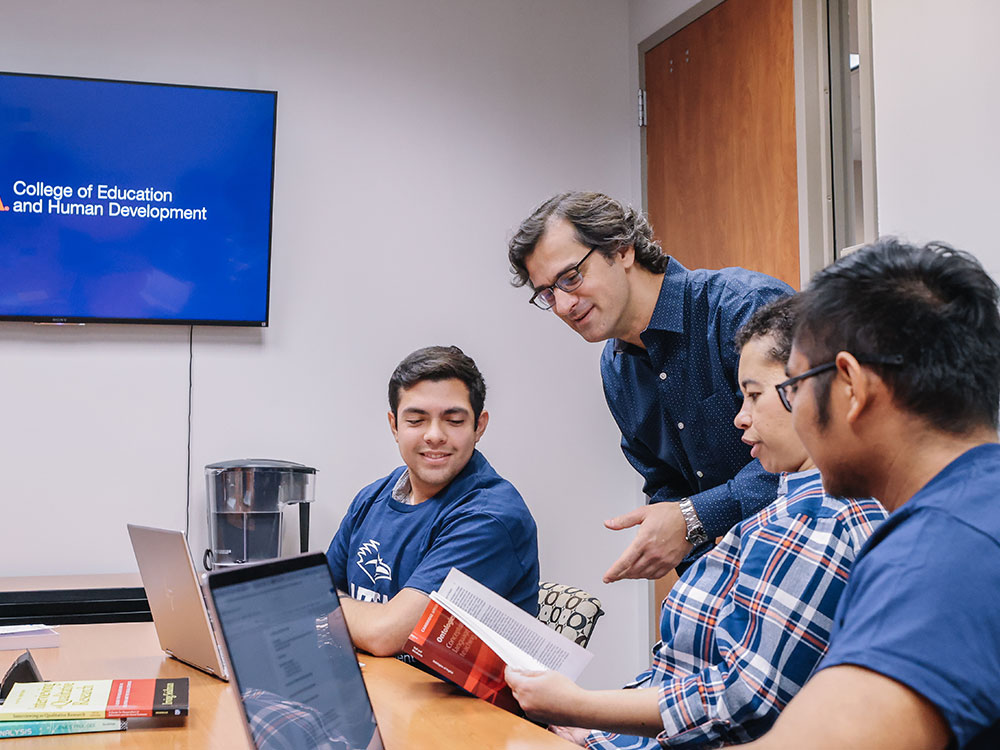
The CLL doctoral program has esteemed faculty members that are nationally and internationally recognized experts in their respective fields. Take a look at some of the current research topics:
- Academic literacy practices and second-language learners.
- Anthropology and education.
- Applied linguistics in multi-ethnic and multicultural settings.
- Autoethnography and identity development.
- Bilingual education, emergent bilingual learners, bilingual teacher preparation, dual-language programs.
- Biliteracy, multicultural children’s literature.
- Chicanx/Latinx education and Chicana feminisms.
- Communities in diasporas and other transnational settings.
- Computer-assisted second language acquisition.
- Digital literacies and social network spaces.
- Education, language policies, and programs for linguistically diverse students.
- Ethnographic and qualitative research methods.
- Teacher language awareness.
Admission & Application Requirements
Applications are submitted through the UT San Antonio Graduate Application. Please upload all required documents (listed below) on your UT San Antonio Graduate Application. It is the applicant’s responsibility to ensure completion and submission of the application, a nonrefundable application fee, and all required supporting documents are on file with UT San Antonio by the appropriate application deadline.
| Culture, Literacy and Language (PhD) | ||
|---|---|---|
| Admission is only available for the Fall semester | ||
| Required Degree | Master’s Degree from an accredited college or university in the United States or have proof of equivalent training at a foreign institution. | |
| Minimum GPA | 3.5 (on a 4.0 scale) Departments may consider GPA of last 60 semester credit hours | |
| Coursework | Completed adequate credit hours or foreign institution equivalent coursework as preparation for the program. | |
| Transcripts* | Required from all institutions attended; international transcripts must be recorded/translated to English | |
| Credential Evaluation | Required if you have earned university-level credit from foreign institutions. Submit an evaluation of your transcripts from FCSA or any NACES-approved credential evaluation agency. | |
| English Language Proficiency | 85 TOEFL iBT / 6.5 IELTS / Duolingo 120 For exams taken on or after January 21, 2026: We require a minimum TOEFL iBT score of 4.0. |
|
| Purpose Statement | Required (max. 5 pages, double-spaced). Describe your research interests, reasons for seeking doctoral study and connections between interests/professional goals and the Culture, Literacy and Language program. The statement should also discuss your experience learning, using, studying or speaking a language other than English. | |
| Resume | Required | |
| Letters of Recommendation | 2 academic or professional reference(s) demonstrating your attributes for successful completion of this program (you will request these through the Graduate Admissions Application; let your recommenders know of your deadline to ensure submissions are on time) | |
| Writing Sample | Required A sample of academic writing such as a paper written for a course, a master’s thesis, or a scholarly publication. | |
| Language | Required Proficiency or experience learning, using, studying or speaking a language other than English | |
| *Unofficial transcripts will be taken into consideration for admissions; however, if admitted into the program, you must submit official transcripts to the University. | ||
Application Deadlines
Applicants are encouraged to have their admission file completed as early as possible. All applications, required documents and letters of recommendation, if applicable, must be submitted by 5:00 PM U.S. Central Time on the day of the deadline. Deadlines are subject to change.
| Culture, Literacy and Language (PhD) | |||
|---|---|---|---|
| Timing on Admission Decision: Completed applications are reviewed after the application deadline. Admission decisions are released following review committee meetings in mid-March. | |||
| Application Deadlines for: | Priority | International | Domestic |
| Fall 2027 | February 1 | February 1 | |
| Spring | Not Available | Not Available | |
| Summer | Not Available | Not Available | |
Funding Opportunities
UT San Antonio offers competitive fellowships to students enrolled full-time in the doctoral program in CLL. For more information about graduate funding, click below.
Learn More
Career Options
Graduates of the PhD in Culture, Literacy and Language (CLL) are prepared for careers across higher education, K–12 leadership and research and policy organizations. With interdisciplinary training in literacy, culture, applied linguistics and education, alumni develop the skills to design and lead programs, conduct impactful research and support bilingual and multilingual learning in diverse contexts. Graduates are well positioned for faculty roles, district and program leadership and cross-sector work that addresses language and literacy in multicultural and multilingual communities.
UT San Antonio prepares you for future careers that are in demand. The possible careers below are based on data pulled by a third-party tool called Emsi, which pulls information from sources like the U.S. Bureau of Labor Statistics, U.S. Census Bureau, online job postings, other government databases and more to give you regional and national career outlook related to this academic program.
This program is housed on the Downtown Campus. Courses are offered in the evenings (6:00 PM to 8:45 PM) to fit the schedules of both full-time students and working professionals. We also offer summer courses in the evenings to help students advance in their program.
Frequently Asked Questions
The UT San Antonio PhD program in Culture, Literacy and Language focuses on the consequences and outcomes of cultural and linguistic diversity for literacy, language learning, and language use. The faculty aims to provide you with an interdisciplinary approach that foster a strong foundation in the fields of cultural studies, literacy development and language acquisition. Graduates will be well-grounded in the theoretical, conceptual and research methodology used to study culture, literacy and language and will be prepared to conduct interdisciplinary research in multicultural-multilingual contexts.
Program length can vary by student depending on factors like transfer credits, pace of coursework and dissertation progress. The average time to graduate is four and a half years.
To get an accurate estimate for your situation, contact the Graduate Advisor of Record (GAR) or our Student Development Specialist ([email protected]). They can walk you through typical timelines for full-time and part-time students.
Because the Culture, Literacy and Language program is interdisciplinary, all doctoral students acquire understanding of the interrelatedness among culture, literacy and language. In this way they are prepared to become leaders of research and development efforts in educational institutions, social and community organizations, and businesses throughout San Antonio, Texas, the nation, and the world. Half of our graduates work as professors in institutions of higher education.
Yes, the PhD in Culture, Literacy and Language offers strong research opportunities with faculty. The doctoral program has esteemed faculty members that are nationally and internationally recognized experts in their respective fields and students work with them in a vibrant, interdisciplinary environment.
Current faculty research areas include topics such as academic literacy and second-language learners, anthropology and education, bilingual education and dual-language programs, biliteracy and multicultural children’s literature, Chicanx/Latinx education, digital literacies, computer-assisted second language acquisition, language policies for students who speak multiple languages, and ethnographic/qualitative research methods. For more detail on how you could get involved, you can also explore the department website.
Yes, funding is available for the PhD in Culture, Literacy and Language. We offer competitive fellowships to students enrolled full-time in the CLL doctoral program. For more details on types of support and how to apply, visit our graduate teaching assistantship and funding information webpage: https://education.utsa.edu/programs/grad-teaching-assistantship-funding.html
Over half of CLL alumni work in institutions of higher education as professors. Our graduates also serve as school supervisors, campus leaders, school improvement facilitators, immersion teachers, language support specialists, directors of education and educational consultants.