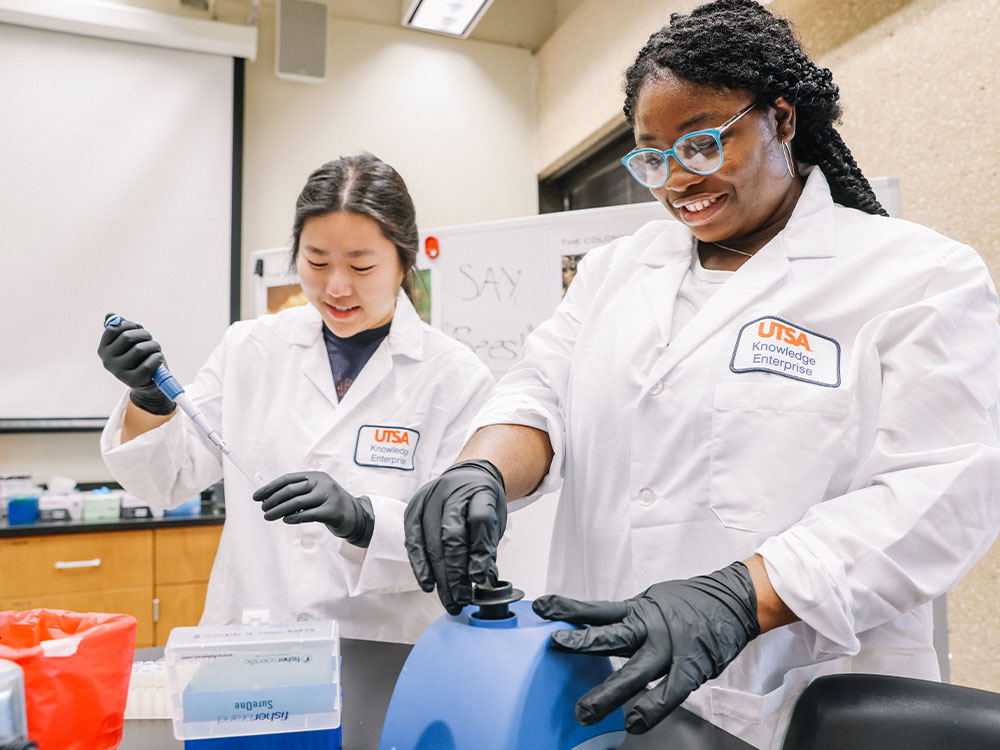
Why Pursue a Biology Master's Degree
The Master of Science degree in Biology offers non-thesis and thesis options to cater to different graduate journeys. Individual programs are organized around each student’s interests in consultation with the student’s graduate advisor. Graduate faculty research interests include biochemistry, cellular biology, developmental biology, ecology, genomics, immunology, microbiology, neuroscience, physiology, and plant sciences.
Thesis
A thesis option is offered to students who want an opportunity to develop expertise in research techniques and data analysis.
There are four emphases within which to conduct a thesis:
The thesis option is recommended for students who plan a career in research or contemplate pursuing a doctorate in one of the life sciences. Students doing a thesis conduct four semesters of research.
Initially all students will be accepted into the Open Emphasis. Those who wish to do a thesis and who are qualified for a particular track can declare a thesis track no later than the end of their first semester, at which time students will have identified a faculty member willing to be their thesis research supervisor. Research can be supervised by a faculty member in the BHE, MMI, or NDRB department.
Non-Thesis
A non-thesis, Open Emphasis, option is offered for those who want the opportunity to earn the Master of Science degree through organized coursework. This option is suitable for those interested in life science careers that are not research-based including, for example, secondary school teaching, health professions, scientific outreach and communication, and health and environmental organizations.
A second, non-thesis track is the Pre-professional Human Health Emphasis.This is an intensive 3-semester program that helps to prepare students for the rigors of professional school.
To be considered for Open Emphasis applicant must have:
- Upper division courses with a grade of at least B in at least 3 of the following courses
- Advanced Physiology
- Biochemistry
- Biostatistics
- Cell Biology
- Ecology
- Immunology
- Microbiology
- Molecular Biology
- Neurobiology/neuroscience
- Plus 1 other relevant upper division course
FALL ADMISSIONS ONLY
To be considered for Pre-professional Human Health Emphasis applicant must have:
- Must have a minimum Undergraduate GPA of 3.3 or higher
- Upper division courses with a grade of at least B
- Biochemistry
- Cell biology
- Advanced Physiology
- plus 1 other relevant upper division course
In the Spotlight

Admission & Application Requirements
Applications are submitted through the UT San Antonio Graduate Application. Please upload all required documents (listed below) on your UT San Antonio Graduate Application. It is the applicant’s responsibility to ensure completion and submission of the application, a nonrefundable application fee, and all required supporting documents are on file with UT San Antonio by the appropriate application deadline.
| Biology (MS) | ||
|---|---|---|
| Required Degree | Bachelor's Degree from an accredited college or university in the United States or have proof of equivalent training at a foreign institution. | |
| Minimum GPA | 3.0 (on a 4.0 scale) Departments may consider GPA of last 60 semester credit hours | |
| Coursework | Completed adequate credit hours or foreign institution equivalent coursework as preparation for the program. | |
| Transcripts* | Required from all institutions attended; international transcripts must be recorded/translated to English | |
| Credential Evaluation | Required if you have earned university-level credit from foreign institutions. Submit an evaluation of your transcripts from FCSA or any NACES-approved credential evaluation agency. | |
| English Language Proficiency | 79 TOEFL iBT / 6.5 IELTS / Duolingo 100 For exams taken on or after January 21, 2026: We require a minimum TOEFL iBT score of 4.0. |
|
| Purpose Statement | Required the statement should describe future plans, including why you want to pursue an MS in Biology and why you want to participate in a particular thesis or non-thesis option (as described in the catalog). | |
| Letters of Recommendation | 2 academic or professional reference(s) demonstrating your attributes for successful completion of this program (you will request these through the Graduate Admissions Application; let your recommenders know of your deadline to ensure submissions are on time) | |
| *Unofficial transcripts will be taken into consideration for admissions; however, if admitted into the program, you must submit official transcripts to the University. | ||
Application Deadlines
Applicants are encouraged to have their admission file completed as early as possible. All applications, required documents and letters of recommendation, if applicable, must be submitted by 5:00 PM U.S. Central Time on the day of the deadline. Deadlines are subject to change.
| Biology (MS) | |||
|---|---|---|---|
| Timing on Admission Decision: Completed applications will be reviewed as they are received. Decisions generally will be made and sent to applicants within 4 to 6 weeks of receiving the completed application. | |||
| Application Deadlines for: | Priority | International | Domestic |
| Spring 2027 | October 1 | November 1 | |
| Summer 2027 | Not Available | Not Available | |
| Fall 2027 | June 1 | June 1 | |
| Spring 2028 | October 1 | November 1 | |
| Summer 2028 | Not Available | Not Available | |
Funding Opportunities
Qualified students are encouraged to apply for teaching assistantships and fellowships. For more information about graduate funding, click below.
Learn MoreCareer Options
UT San Antonio prepares you for future careers that are in demand. The possible careers below are based on data pulled by a third-party tool called Emsi, which pulls information from sources like the U.S. Bureau of Labor Statistics, U.S. Census Bureau, online job postings, other government databases and more to give you regional and national career outlook related to this academic program.
Frequently Asked Questions
Our Master of Science in Biology is a multidisciplinary graduate program that offers advanced study and research across many areas of the life sciences.
Students in the MS Biology program can take classes and conduct research with faculty in the Biology, Health, and the Environment Department, the Molecular Microbiology and Immunology Department, and the Neuroscience, Development, and Regenerative Biology Department. The degree offers both thesis and non-thesis options, with individual programs planned around each student’s interests in consultation with a graduate advisor. Thesis students can focus in areas such as Developmental and Regenerative Science, Ecology, Microbiology and Immunology or Neuroscience.
The MS Biology program is designed for students seeking advanced, multidisciplinary training in the life sciences, offering opportunities to take courses and conduct research across multiple departments, including Biology, Health, and the Environment; Molecular Microbiology and Immunology; and Neuroscience, Development, and Regenerative Biology. It is suited for students who want either a research‑focused thesis path or a flexible non‑thesis option, with individualized study plans developed alongside a graduate advisor. Thesis‑track students can further specialize in areas such as Developmental and Regenerative Science, Ecology, Microbiology and Immunology or Neuroscience.
The curriculum covers core areas of study and research in:
- Biochemistry
- Cellular biology
- Developmental biology
- Ecology
- Genomics
- Immunology
- Microbiology
- Neuroscience
- Physiology
- Plant sciences
The MS Biology program typically takes about 2 years to complete, depending on the route (thesis or non‑thesis) and the course load you choose while in the program. It is designed as a two‑year program, usually four long semesters for full‑time students.
Program graduates are prepared for careers in research, biotechnology, pharmaceuticals, environmental science and healthcare‑related industries, with roles such as research associate, laboratory scientist or quality control analyst. The program also provides a strong foundation for students pursuing PhD programs or professional schools in medicine, dentistry or other health fields.
Financial support is available for students in the MS Biology program at UT San Antonio. Students may access federal financial aid options such as grants and loans. UT San Antonio also offers a variety of scholarships through the Scholarship Hub, where students can apply for department‑specific and university‑wide awards. In addition, qualified students may pursue graduate assistantships, which require contacting the department and submitting an application for available teaching or research assistant roles.
In the News
The University of San Antonio continues working towards the betterment of society through research. Mariah Hopkins, PhD, from the Department of Biology, Health and the Environment, is studying a possible new method to detect New World screwworm larvae. New World screwworm can be catastrophic to agriculture and ecosystems, infecting many warm-blooded organisms from livestock to household pets. Through the use of environmental DNA (eDNA), an up-and-coming technology that allows scientists to identify organisms based on traces of genetic material found in the environment such as water and soil. Not only is Hopkins hoping for a more effective way to combat these parasites, but the initiative is also serving as a hands-on learning opportunity for UT San Antonio students.
Hopkins’ work studying eDNA began through the university’s Course-Based Undergraduate Research Experiences (CUREs) program, which allows more than 1,000 students every year to conduct original research projects as part of their coursework.
Read the full story “UT San Antonio eDNA research targets real-world challenges in agriculture and public health” to learn more about this impactful research.
For more news stories, visit UT San Antonio today.