
Why Pursue a PhD in Aerospace Engineering
The Aerospace Engineering PhD program prepares students to be leaders in industry and academia, with focused research in areas like aerodynamics, propulsion, hypersonics, structures, and space sciences. Graduates are prepared to solve current engineering challenges, motivated to ask new questions and develop innovative solutions.
Through a dynamic partnership with Southwest Research Institute (SwRI), leading researchers and scientists enhance the academic experience through student mentorship and specialized coursework. Graduates can go on to pursue positions in advanced research and development at organizations like NASA, national laboratories, or innovative companies. Others apply their expertise in academia, government, defense, or consulting.
Research & Facilities
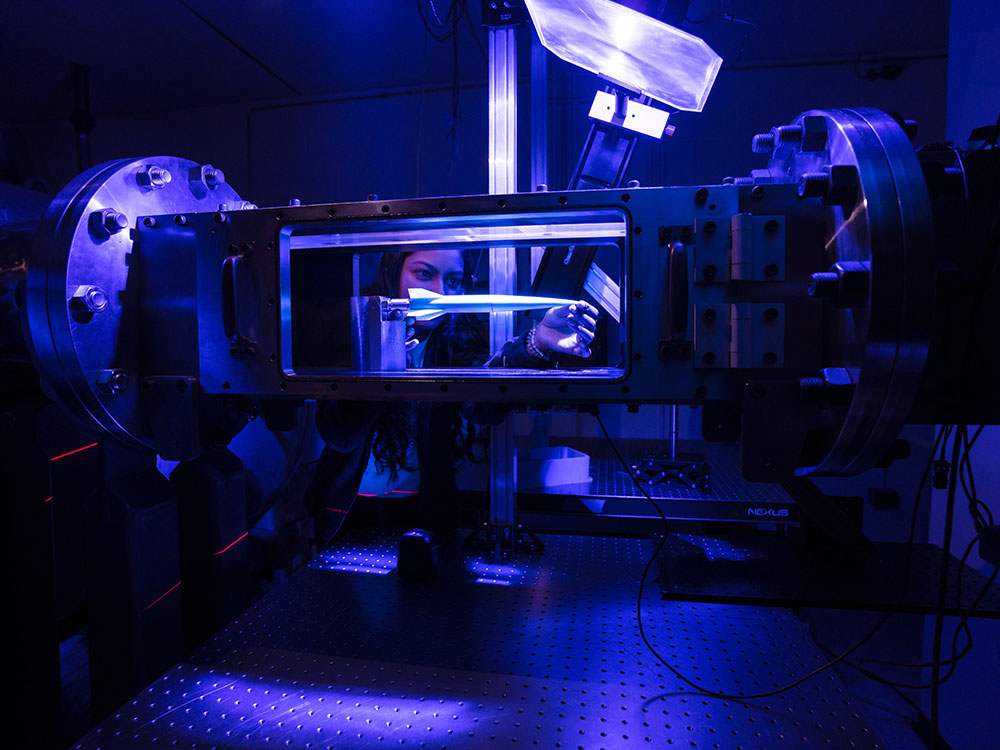
UT San Antonio’s facilities support PhD-level research through access to advanced laboratories and testing environments. The campus hosts laboratories such as the Hypersonics Lab with a 50-foot Mach 7 Ludwieg tube wind tunnel, one of only a few at U.S. universities for high-speed aerodynamics testing.
Students also benefit from the Applied Engineering and Technology Building, Large-Scale Testing Laboratory, Makerspace, and other research facilities where students work with CAD tools, advanced manufacturing equipment, and collaborative project spaces. These facilities support real-world research, design, and experimentation that enhances technical skills and prepare students for careers in aerospace and related fields.
Admission & Application Requirements
Applications are submitted through the UT San Antonio Graduate Application. Please upload all required documents (listed below) on your UT San Antonio Graduate Application. It is the applicant’s responsibility to ensure completion and submission of the application, a nonrefundable application fee, and all required supporting documents are on file with UT San Antonio by the appropriate application deadline.
| Aerospace Engineering (PhD) | ||
|---|---|---|
| Required Degree | Bachelor's Degree from an accredited college or university in the United States or have proof of equivalent training at a foreign institution. | |
| Minimum GPA | 3.0 (on a 4.0 scale) Departments may consider GPA of last 60 semester credit hours | |
| Coursework | Completed adequate credit hours or foreign institution equivalent coursework as preparation for the program. | |
| Transcripts* | Required from all institutions attended; international transcripts must be recorded/translated to English | |
| Credential Evaluation | Required if you have earned university-level credit from foreign institutions. Submit an evaluation of your transcripts from FCSA or any NACES-approved credential evaluation agency. | |
| English Language Proficiency | 79 TOEFL iBT / 6.5 IELTS / Duolingo 100 For exams taken on or after January 21, 2026: We require a minimum TOEFL iBT score of 4.0. |
|
| Purpose Statement | Required | |
| Resume | Required | |
| Letters of Recommendation | 2 academic or professional reference(s) demonstrating your attributes for successful completion of this program (you will request these through the Graduate Admissions Application; let your recommenders know of your deadline to ensure submissions are on time) | |
| *Unofficial transcripts will be taken into consideration for admissions; however, if admitted into the program, you must submit official transcripts to the University. | ||
Application Deadlines
Applicants are encouraged to have their admission file completed as early as possible. All applications, required documents and letters of recommendation, if applicable, must be submitted by 5:00 PM U.S. Central Time on the day of the deadline. Deadlines are subject to change.
| Aerospace Engineering (PhD) | |||
|---|---|---|---|
| Timing on Admission Decision: Completed applications are reviewed after the application deadline. Admission decisions are released in batches following review committee meetings in early August. | |||
| Application Deadlines for: | Priority | International | Domestic |
| Spring 2027 | October 1 | November 1 | |
| Summer 2027 | Not Available | Not Available | |
| Fall 2027 | February 1 | August 1 | |
| Spring 2028 | October 1 | November 1 | |
| Summer 2028 | Not Available | Not Available | |
Funding Opportunities
PhD students may qualify for research or teaching positions, for which the Klesse College offers funding related to tuition, medical insurance, and an annual stipend of $26,000.
Learn MoreCareer Options
UT San Antonio prepares you for future careers that are in demand. The possible careers below are based on data pulled by a third-party tool called Emsi, which pulls information from sources like the U.S. Bureau of Labor Statistics, U.S. Census Bureau, online job postings, other government databases and more to give you regional and national career outlook related to this academic program.
The program offers a comprehensive selection courses, with topics like:
- Hypersonics
- Propulsion
- Computational fluid dynamics
- Engineering optics
- Big data
- Aircraft performance
Visit the Graduate Catalog for a full list of courses and degree requirements.
This program takes about 3 years to complete if entering with a Master of Science (MS), or about 5 years if entering with a Bachelor of Science (BS).
Expert Faculty
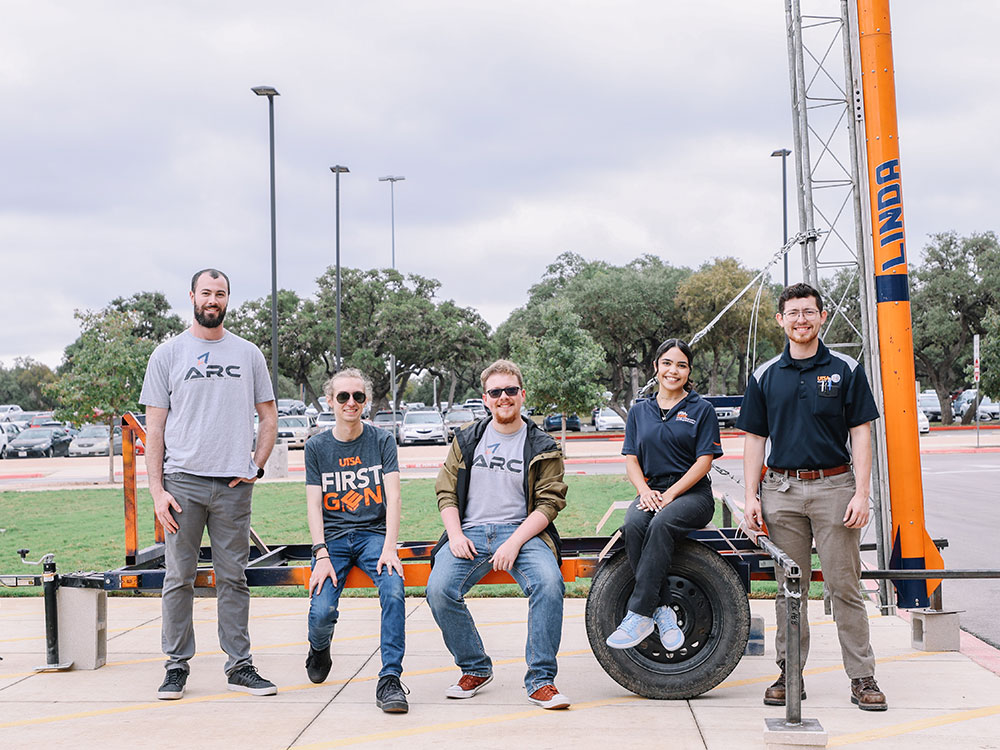
The Department of Mechanical, Aerospace, and Industrial Engineering boasts a large, diverse faculty of professors and researchers with PhDs who support both classroom learning and advanced research. The department features nationally recognized scholars, award recipients, and active researchers who can mentor students in hands-on projects, guide graduate research, and connect students to industry and academic opportunities.
In the News
The University of Texas at San Antonio just became one of only four universities in the state to offer a PhD in aerospace engineering. This program, offered by the Klesse College of Engineering and Integrated Design, comes from a growing demand in Texas for experts in the aerospace field, with the projected employment of aerospace engineers in the state set to grow by nearly 16% over the next decade.
Read the full story “UT San Antonio launches aerospace engineering PhD to meet growing workforce needs in Texas” to learn more about the introduction of this program.
Researchers at the Southwest Research Institute (SwRI) and the UT San Antonio are working together to better understand solid rocket propellant. By learning more about how the rocket propellant burns, they hope to improve its efficiency and design for defense and aerospace applications.
Read the full story “Researchers from SwRI, UT San Antonio collaborate to better understand solid rocket propellants” to learn more about this innovative research.
For more news stories, visit UT San Antonio today.