Why Pursue a PhD in Physics
The Physics PhD program is one of the fastest-growing programs in the state, ranking as the fifth largest graduate Physics program in Texas (according to the statistics of the American Institute of Physics). This program offers cutting-edge and diverse areas of research, as seen through collaboration with the Space Science Division of the Southwest Research Institute. Following commencement, 88% of graduates immediately found employment.
SwRI-UTSA Space Physics and Instrumentation
If students choose to work with the core scientists from the Southwest Research Institute Space Science and Engineering Division, opportunities are available in the fields of:
- space weather
- ionosphere-thermosphere-mesospheric physics
- plasmaspheric physics
- magnetospheric physics
- heliospheric physics, cometary physics
- space physics instrumentation, and computational space physics
In the Spotlight

Research Opportunities
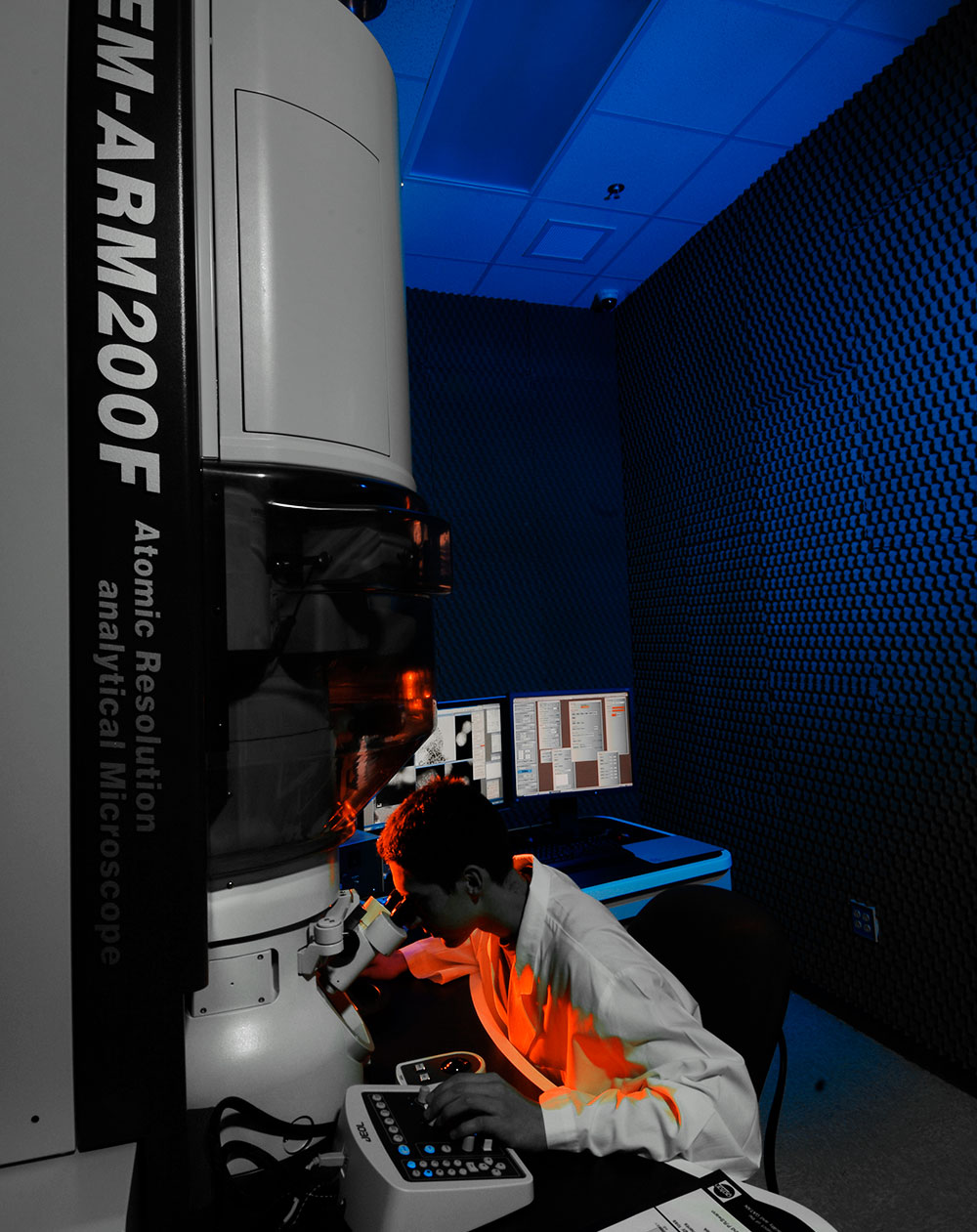
Doctoral students work closely with faculty and mentors from the Department of Physics and Astronomy to conduct cutting-edge research. Research topics include, but are not limited to:
- Nanoparticles
- Advanced thin film technology
- Biophotonics
- Protein structure
- Integrated experimental/computational approach to molecular biophysics
- Advanced materials (e.g., photonics crystals)
- Research in terahertz application
- Computational condensed matter
- Space physics
- Space instrumentation
Research Specializations
The Department of Physics and Astronomy offers undergraduate and graduate students research opportunities in six principal areas:
Admission & Application Requirements
Applications are submitted through the UT San Antonio Graduate Application. Please upload all required documents (listed below) on your UT San Antonio Graduate Application. It is the applicant’s responsibility to ensure completion and submission of the application, a nonrefundable application fee, and all required supporting documents are on file with UT San Antonio by the appropriate application deadline.
| Physics (PhD) | ||
|---|---|---|
| Required Degree | Bachelor's Degree from an accredited college or university in the United States or have proof of equivalent training at a foreign institution. | |
| Minimum GPA | 3.0 (on a 4.0 scale) Departments may consider GPA of last 60 semester credit hours | |
| Coursework | Completed adequate credit hours or foreign institution equivalent coursework as preparation for the program. | |
| Transcripts* | Required from all institutions attended; international transcripts must be recorded/translated to English | |
| Credential Evaluation | Required if you have earned university-level credit from foreign institutions. Submit an evaluation of your transcripts from FCSA or any NACES-approved credential evaluation agency. | |
| English Language Proficiency | 79 TOEFL iBT / 6.5 IELTS / Duolingo 100 For exams taken on or after January 21, 2026: We require a minimum TOEFL iBT score of 4.0. |
|
| Purpose Statement | Required | |
| Resume | Required | |
| Letters of Recommendation | 2 academic or professional reference(s) demonstrating your attributes for successful completion of this program (you will request these through the Graduate Admissions Application; let your recommenders know of your deadline to ensure submissions are on time) | |
| *Unofficial transcripts will be taken into consideration for admissions; however, if admitted into the program, you must submit official transcripts to the University. | ||
Application Deadlines
Applicants are encouraged to have their admission file completed as early as possible. All applications, required documents and letters of recommendation, if applicable, must be submitted by 5:00 PM U.S. Central Time on the day of the deadline. Deadlines are subject to change.
| Physics (PhD) | |||
|---|---|---|---|
| Timing on Admission Decision: Applicants can expect to receive an admission decision within 4 to 6 weeks after the posted deadline. | |||
| Application Deadlines for: | Priority | International | Domestic |
| Spring 2027 | October 1 | October 1 | |
| Summer 2027 | Not Available | Not Available | |
| Fall 2027 | December 1 | December 1 | |
| Spring 2028 | September 1 | September 1 | |
| Summer 2028 | Not Available | Not Available | |
Funding Opportunities
The Physics and Astronomy Department has about 40 Graduate Research Assistant (GRA) and 40 Teaching Assistant (TA) positions for support of incoming and continuing PhD seeking graduate students. New students typically receive a commitment for their first year and will continue to be hired based on adequate progress toward completing the degree.
During their first academic year, PhD students appointed as GRAs or TAs will receive an annual stipend (currently $24,000) paid in monthly allotments, health coverage (currently $3,200), plus tuition and fees in the amount of $11,900.
For more information about fellowships, click below.
Learn MoreCareer Options
UT San Antonio prepares you for future careers that are in demand. The possible careers below are based on data pulled by a third-party tool called Emsi, which pulls information from sources like the U.S. Bureau of Labor Statistics, U.S. Census Bureau, online job postings, other government databases and more to give you regional and national career outlook related to this academic program.
While in a doctoral program, a student may earn a master’s degree provided the following conditions are satisfied:
- A student must be admitted to candidacy.
- A student is eligible to receive a master’s degree upon completion of University-wide requirements and any additional degree requirements specific to the program.
- The Doctoral Studies Committee, Department Chair, and the Graduate Associate Dean of the College must recommend students for the degree.
- The student must apply for graduation by the published deadline the semester prior to awarding the doctoral degree.
- All required coursework in the doctoral program at the time of admission to candidacy must have been taken within the previous six years.
- If the master’s degree requires a thesis, the degree cannot be awarded on the basis of the doctoral qualifying examination.
- Students will not be approved for an additional master’s degree in the same field in which an individual has previously received a master’s degree.
This program is housed at Main campus. Courses are offered at various times of the day, generally scheduled later in the afternoon.
Frequently Asked Questions
The Department of Physics and Astronomy, in partnership with the Southwest Research Institute, offers opportunities for advanced studies and research leading to the Doctor of Philosophy (Ph.D.) degree in Physics. The Ph.D. in Physics is awarded to candidates who have displayed an in-depth understanding of the subject matter and demonstrated the ability to make an original contribution to knowledge in their field of specialty.
Major research fields include biophysics, materials physics, and astronomy/astrophysics. We feature a concentration in materials science and a cooperative program in Space Physics with the Southwest Research Institute.
PhD students take 4 core classes, several electives and 48 hours of research credit. They complete a qualifying exam and thesis proposal at the end of year 2, and a dissertation defense to complete their degree.
PhD physics graduates may find employment in academia, industrial research and development, education and government/national labs. Many of our PhD students find employment as software developers, data analysts and other careers that require quantitative skills. PhD students publish their research in original peer reviewed articles, and make novel contributions to their scientific discipline.
In addition to satisfying the University-wide graduate admission requirements, applicants must have a Bachelor of Arts or a Bachelor of Science degree from an accredited university and a minimum grade point average of 3.0 (on a 4.0 scale) in upper division undergraduate coursework and all graduate work, preferably in physics. A minimum of two letters of recommendation from persons familiar with the applicant’s undergraduate (and graduate, where applicable) scholastic record must be sent to Graduate Admissions at the same time application is made for admission to UT San Antonio, along with a statement of purpose and a current résumé. Background or remedial courses in physics may be required to remove deficiencies. Applicants whose native language is not English must submit scores from the Test of English as a Foreign Language (TOEFL) iBT or the International English Language Testing System (IELTS). The English Language Assessment Procedure is a mandatory assessment for incoming international students whose TOEFL iBT scores are between 79 and 100 or an IELTS score below 7.
Physics PhD students are appointed as research assistants or teaching assistants and receive a competitive annual stipend (currently $27,000 to $30,000) paid in monthly allotments. Tuition and fees are also paid by the program, as well as health insurance for a package estimated around $43,000
In the News
UT San Antonio researcher and physics professor Chonglin Cheng, PhD and his team have made a breakthrough in producing clean energy. Their work provides a solution for the problematic high temperatures required for using solid oxide fuel cells as a green energy source. This development is a huge step towards using clean energy on a larger scale. This is just one example of our Roadrunners pursuing innovative paths of research for the betterment of society.
Read the full article “Freezing fire: UT San Antonio scientists discover breakthrough for green energy” to learn more about this incredible advancement in the pursuit of clean energy.
For more news stories, visit UT San Antonio today.